Emergency Help
 Location
ORTHODONTIC TREATMENTS
Invisalign First
When it comes to teeth, we can set things straight
What is Invisalign First?
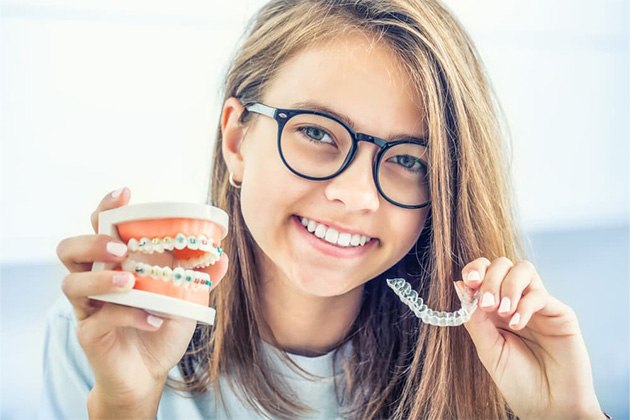
Invisalign First is an orthodontic treatment device specially designed for young children. It is used to correct issues with arch development and expansion, tooth crowding and spacing, tooth protrusions, and the overall appearance of a child’s smile.
The custom-designed Invisalign First trays are designed to gradually expand the jawline of a growing child.
Common Children’s Orthodontic Problems

8 Ways Parents Can Reduce Their Child’s Risks Of Developing Orthodontic Problems
- Book your child’s first orthodontic evaluation: We encourage parents to schedule their child’s first visit with a pediatric orthodontist by the time they’re seven years of age.
If you do notice that your child’s teeth seem to be crooked or crowded, it’s always a good idea to seek out the expertise of a pediatric orthodontist, even if your child is still very young. - Wean your child from thumbsucking and pacifier habits : Thumbsucking and pacifier habits can be endearing, but it’s important for parents to also remember that these habits should end around preschool. Prolonged thumbsucking and pacifier use quickly lead to a severe overbite.
- Keep a regular schedule of dental checkups with a pediatric dentist: Taking your child to their pediatric dentist for checkups and cleanings every six months can lessen the risks of orthodontic issues. The sooner signs of trouble are spotted, the sooner a solution can be found.
- Establish daily brushing and flossing routines for the morning and evening: The foundation of your child’s oral health begins right at home with a twice-daily thorough brushing and flossing routine. Start your child’s at-home dental care routine as early on as possible.
Your kid’s oral health can have either a positive or negative impact on the alignment of their teeth and overall bite. The healthier your child’s smile, the stronger their teeth will be. - Provide a nutritious diet with plenty of whole, natural foods: Evaluate your child’s diet and see how you might be able to make some smile-friendly changes. Basing main meals around whole, natural foods and limiting processed foods is a great way to start!
- Get help if your child often mouth breathes during the day or at night: Mouth breathing isn’t uncommon, but it can spell trouble if your child develops a habit of doing it. As far as oral health goes, mouth breathing can cause dry mouth, which drastically increases your child’s risk of tooth decay and can weaken their jaw structure.
Not only can mouth breathing cause orthodontic issues for your child, but it can also complicate future orthodontic treatment if the habit continues at that time. - Follow through with early orthodontic treatment recommendations: The average age for braces is between 12 and 14 years of age, but this can vary greatly. In some cases, your child’s orthodontist may recommend early treatment, sometimes as early as eight years of age.
- Encourage your child to sleep on their back and practice proper posture: Two more habits that will have a positive impact on your child’s bite alignment are sleeping position and posture. Stomach sleeping is natural for some kids, but it can gradually cause their teeth and jaw position to shift due to the hours of constant pressure.
Why Invisalign First?
- Arch development
- Expansion
- Spacing/crowding
- A-P correction
- Aesthetic alignment
- Tooth protrusions or interferences
Who Needs Invisalign First treatment?
What types of conditions can Invisalign First treatment address?
Invisalign First clear aligners are designed for developing dental arch form and creating space for permanent erupting dentition.
They can also be used to address conditions such as dental arch development, expansion, spacing/crowding, A-P correction, aesthetic alignment, tooth protrusions, or interferences.
Invisalign’s First Phase 1 treatment is also designed to improve the efficiency of Phase 2 treatment.
Please note that Invisalign First clear aligners currently do not have specially designed solutions to address Class III, palatal expansion, and some habitual problems.
Pros And Cons Of Invisalign First
Pros
Cons
- Allowing younger children to receive a similar Invisalign experience to adults and teens
- Customized planning around your child’s unique dental needs
- Treatment for a broad range of orthodontic malformations
- Providing room for incoming teeth without removing surrounding teeth
- Supporting teeth and jawline formation with preferred aesthetics vs. traditional braces
- Your child can remove the device to maintain comfort while eating, drinking, brushing their teeth, or doing other activities
- The need to have self-discipline and motivation to wear aligners exactly as instructed
- Having to change some habits, such as frequent snacking or sipping of beverages.
- Speaking can be difficult for the first week or so.
- Braces are an expeCertain tooth and bite problems may be more difficult or require more time to treat with Invisalign than with braces.nsive proposition.
Initial Consultation
Invisalign First works by expanding and contouring your child’s jawline through what is known as dental arch expansion. The dental arch expansion involves pushing your child’s teeth over time to increase the width of their dental arch.
The procedure for dental arch expansion starts with a consultation to determine if your child is an appropriate candidate for Invisalign First. If approved, your child’s dentist can begin taking pictures, x-rays, and impressions of your child’s smile that same day.
During The Invisalign First Procedure
Information from the imaging, x-rays, and impressions will go to an Invisalign lab where a custom Invisalign First device, called an aligner or tray, will be made for your child.
It will take a few weeks until the custom aligner is ready. Once the aligner is ready, your child will be scheduled to come back to Weber Orthodontics for his or her dentist to fit the aligner to your child’s smile. Over time the device will shift your child’s teeth around as needed and new retainers will be needed for the following phases of treatment.
Depending on your child’s needs, he or she may require a full pair of aligners or just one aligner. Certain teeth may require attachments to be placed on their surface. Attachments will help direct pressure from the retainer device to the necessary teeth.
What happens after the first round of Invisalign?
What are the adverse effects of clear aligners?
- Breathing difficulty- Placement of aligners can hamper the normal breathing process and one may feel suffocated after wearing them
- Sore throat and tongue- Soon after wearing aligners one may experience a sore throat. This can hamper swallowing which may further result in other health complications
- Itchiness and hives- Tooth aligners can irritate oral mucosa and may result in extreme itchiness and breakouts
- At times wearing aligners may cause nausea painful ingestion of food, dryness of mouth, and headaches
- Rarely swelling of the eyes- is also reported with the usage of aligners. Aligners may also cause breakouts on the lips
- A few patients- may also report fatigue, soreness, and breakouts on the tongue.
- Aligners may also put excessive pressure on the gums- thereby resulting in gums problems like swelling and bleeding
FAQ's
After treating with Invisalign First clear aligners, are there retainers available to support pediatric patients?
Doctors are able to order Vivera® retainers and Invisalign retainers. Commercially available retainers (e.g. Hawley, Theroux) are also available.
At this time, Vivera and Invisalign retainers do not have eruption compensation capability to support patients during the course of exfoliating/erupting dentition.
Therefore, Vivera and Invisalign retainers usage between Phase 1 and Phase 2 treatments might be very limited and used only during a limited time period when stable dentition is present.
Are weekly aligner changes possible with Invisalign First treatment?
Can I get compliance indicators with Invisalign First clear aligners?
Do Invisalign First clear aligners provide support for short clinical crowns?
Yes. To improve retention on short clinical crowns, new optimized retention attachments are automatically placed by software.
- Attachments are automatically placed by software on the permanent first molar, primary second molar (or second premolar).
- The attachments adjust and re-size based on the buccal tooth surface, allowing for the largest attachments to be placed for ease of bonding.
- Attachments will be only placed if no other optimized attachments are placed due to the presence of applicable tooth movements or if it does not conflict with your clinical preferences.
Do Invisalign First clear aligners provide support for erupting permanent dentition?
Yes. Improved and expanded eruption compensation (EC) features make it possible to treat patients in early to late mixed dentition.
- Eruption compensation is now also available for incisors (in addition to canines and premolars).
- Advanced proprietary eruption compensation algorithm enables highly accurate space-holding for teeth to naturally erupt into the aligners. Available for upper incisors, canines, and premolars.
- Eruption compensation for lower incisors is available but with non-algorithm calculation.
- Doctors select which teeth for which they would like eruption compensation on the Rx.
Regain Your Happy Smile in Healthy Way
Our Accomplishments